Deep Bite Treatment: Causes, Options, and What to Expect
A small amount of overlap between the upper and lower front teeth is normal. When the upper teeth cover most of the lower teeth, orthodontists call it a deep bite, and deep bite treatment is usually about more than looks. Many Fort Collins families first hear the term at a routine dental cleaning, and it often comes as a surprise because a deep bite can look perfectly fine in a smile photo.
The questions that follow are practical ones. Is it actually a problem? Will it correct itself as a child grows? Do braces fix it, or can clear aligners do the job? And how long does it take?
This guide answers those questions using guidance from the American Association of Orthodontists and recent clinical research. It explains how a deep bite differs from a normal overbite, why orthodontists prefer to correct it, the main treatment approaches for growing kids and for adults, and what the evidence does and does not tell us. It also covers what happens after treatment, because holding a corrected bite in place matters as much as getting there. Every bite is different, so treat this as background reading before a conversation with an orthodontist, not as a diagnosis.
What a deep bite is, and how it differs from a normal overbite
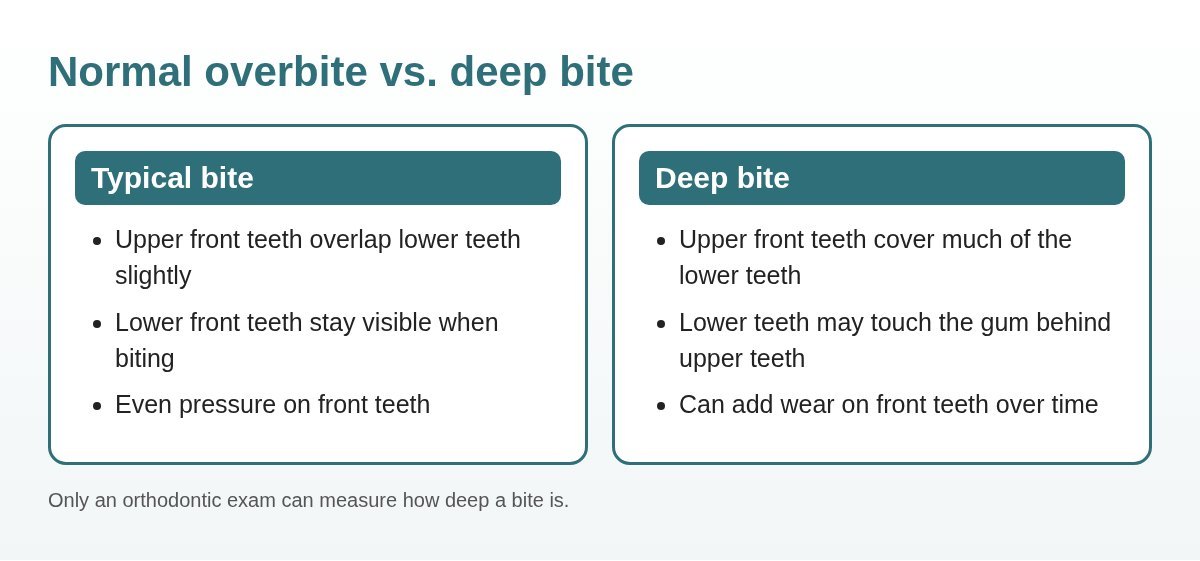
Everyone has some overbite. The upper front teeth normally sit slightly in front of and over the lower front teeth when the back teeth are closed. A deep bite, also called an excessive overbite, is when that vertical overlap becomes much larger than normal, so the upper front teeth hide most of the lower front teeth.
It helps to separate two terms that people often mix up. Overbite describes vertical overlap, how far the upper teeth come down over the lower ones. Overjet describes horizontal distance, how far the upper teeth stick forward. A person can have one, the other, or both, which is why the Milnor blog has a separate explainer on what an overjet is.
A quick check at home is to bite down on the back teeth and look at the front teeth from the side. If very little of the lower front teeth is visible, or if the lower teeth seem to touch the gum behind the upper teeth, it is worth asking about. Only an exam with measurements and records can confirm how deep the bite really is.
Why a deep bite is worth treating
The AAO lists several reasons orthodontists correct a deep bite beyond appearance, and most of them are about protecting teeth and gums over the long term.
- Tooth wear. Lower front teeth that have over-erupted can wear down early and damage the enamel on the back of the upper front teeth.
- Gum damage. Pressure from the bite can injure the gums behind the front teeth and may contribute to gum recession.
- Chewing and sore spots. Repeatedly biting into the roof of the mouth can cause painful sores and make eating uncomfortable.
- Other alignment problems. Left alone, a deep bite can lead to or worsen crowding and spacing.
Grinding makes the wear worse
Clenching and grinding can speed up that wear, which raises the risk of sensitivity and decay. Grinding often happens during sleep without the person knowing, and the ADA’s list of common bruxism signs includes jaw tenderness, dull headaches, and chipped or worn tooth edges. When a lot of tooth structure has already been lost, the AAO notes that an orthodontist may need to open the bite to create room for a dentist to restore the teeth.
None of this means every deep bite is an emergency. It does mean a deep bite is better measured and monitored than ignored.
What causes a deep bite and how it is diagnosed
There is rarely one cause. Researchers describe deep bite as one of the most debated problems in orthodontics, largely because the underlying reasons vary so much from patient to patient. In some people the issue is mostly the teeth, for example front teeth that have erupted too far or are tipped at an angle that deepens the overlap. In others it is mostly the jaws. The AAO notes, for instance, that habitually biting the roof of the mouth almost always points to a short lower jaw. In other words, the lower jaw is small relative to the upper one.
That distinction drives the plan. A deep bite caused mainly by tooth position can often be corrected by moving teeth. One rooted in jaw proportions may call for growth guidance in a child or, in more severe adult cases, a surgical discussion.
So an orthodontist looks at more than the front teeth. An evaluation often includes photos, a digital scan or impressions, and X-rays so the doctor can see how the teeth, jaws, and facial profile relate. Deep bites also travel with other problems, such as crowding, an overjet, or a crossbite in the back teeth, and the plan has to account for all of them together.
Deep bite treatment options
According to the AAO, treatment depends on how severe the overbite is, the patient’s age, and the underlying cause. The three broad approaches are braces, clear aligners, and, for severe cases, surgery combined with orthodontics.
Braces
Braces are the most common way to correct a deep bite. Brackets and archwires apply steady pressure, and the orthodontist adjusts them over time to change how deeply the front teeth overlap. Depending on the case, that can mean leveling the curve of the lower teeth or intruding (moving up into the bone) the upper front teeth. Small bite pads, sometimes called bite turbos, may be bonded to certain teeth to keep the back teeth slightly apart while the bite opens. Patients comparing appliance styles can read more about the types of braces available.
Clear aligners
Clear aligners can also correct many deep bites. They apply pressure through a series of custom trays, and the AAO’s aligner wear guidance notes they are typically worn at least 22 hours a day and can be paired with elastics. The same page is candid that some cases are treated more predictably with braces, so the right choice depends on the bite. Adults and teens who want a less visible option can ask whether clear aligners are suitable for their case.
Surgery for severe skeletal cases
In severe cases, especially in adults whose jaws have stopped growing, orthognathic (jaw) surgery may be needed to reposition the jaws. It is planned together with orthodontic treatment and reserved for problems that tooth movement alone cannot correct.
What the research says about correcting a deep bite
Clinical research on deep bites is less settled than many patients expect. A 2025 systematic review pooled eight randomized controlled trials in adolescents and adults and compared several mechanics, including miniscrew-supported intrusion, intrusion arches, anterior bite turbos, and a reverse curve of Spee in the lower wire.
The findings were useful but modest. Moderate-quality evidence showed that both anterior bite turbos and a reverse curve of Spee reduced overbite effectively. Miniscrew-supported intrusion moved the upper front teeth up more than an intrusion arch, although some of that evidence was rated low quality. The authors described deep bite treatment as one of the most debated topics in orthodontics because the causes and techniques vary so widely.
For patients, the takeaway is simple. No single appliance is best for every deep bite, and a plan that fits the cause of your bite matters more than any one technique.
Deep bite in children versus adults
Age changes the options. In children, the jaws are still growing, which gives an orthodontist more ways to influence how the bite develops. The AAO’s guide to common bite problems recommends that children see an orthodontist by age 7. By then, most kids have a mix of baby and permanent teeth. That mix lets the doctor spot developing bite problems early. Not every child needs treatment at that age. Often the answer is to watch and time treatment well, and Milnor’s page on early orthodontic treatment explains how that first visit works.
In adults, growth is finished, so correction depends on moving teeth, and surgery comes into the discussion only when the jaw relationship is severe. Adults are often good candidates for braces or aligners, and many seek treatment after a dentist notices wear on the front teeth or the backs of the upper teeth. If that sounds familiar, the practice’s adult orthodontics page describes the options for grown-up smiles.
Timing questions are common. Treatment length varies with severity and the approach chosen, so only an exam can give a realistic estimate. As a general reference, the AAO’s braces treatment overview says most people wear braces for 12 to 24 months, while noting that length varies by person and by bite problem.
What treatment feels like day to day
Most people adjust quickly. Teeth may feel tender after braces go on or when a new set of aligners starts, and that soreness usually settles. Bite pads can make chewing feel odd at first. Softer foods and smaller bites help during that stretch.
Cleaning takes a little more effort, too. Brackets, attachments, and bite pads all trap plaque, so careful brushing and daily cleaning between the teeth matter throughout treatment. Regular check-ins let the orthodontist track how the overlap is changing and adjust the plan if the bite is opening faster or slower than expected. Call the office if a bite pad comes loose or something rubs, rather than waiting for the next visit.
Keeping the bite stable after treatment
Deep bites have a reputation for trying to creep back. Teeth naturally tend to drift toward their old positions, which is why retainers are part of every orthodontic plan, and the AAO’s retainer care advice explains that wearing them as prescribed minimizes relapse.
Retainers can be removable or bonded behind the teeth, and your orthodontist will choose the type and wear schedule that suits your corrected bite. Bring any change you notice in how your front teeth meet to your follow-up visits, since small shifts are easier to address early.
The next step for a deep bite in Fort Collins
A deep bite is common, and it is very treatable. It is also one of those problems that rarely improves by waiting, because the overlap can keep wearing teeth, pressing on the gums, and making other alignment issues worse over time.
The right approach depends on why the bite is deep. Teeth that have over-erupted call for a different plan than a short lower jaw, and a growing child has options an adult no longer does. Braces remain the most common tool, clear aligners handle many cases well, and surgery is kept for the most severe skeletal problems. The research supports several techniques, and none of them is best for everyone, so a careful diagnosis matters more than any brand or appliance.
If you have noticed your lower front teeth disappearing behind your upper teeth, sore spots on the roof of your mouth, or wear on your front teeth, it is reasonable to have it checked. The same goes for a child around age 7 whose dentist mentioned an overbite. An orthodontic exam at Milnor Orthodontics in Fort Collins can measure the bite, explain whether treatment makes sense now or later, and lay out the options that fit your teeth, your timeline, and your budget. Bring your questions about cost and insurance too, so you leave with a plan rather than a guess.
Frequently asked questions
How long does it take to correct a deep bite?
It depends on how severe the bite is, the cause, and the appliance used. As a general guide, the AAO says most people wear braces for 12 to 24 months, and your orthodontist can give a personal estimate after an exam.
Can you fix a deep bite naturally?
A deep bite involves the position of the teeth and sometimes the jaws, so it does not correct itself and is not something exercises can be relied on to fix. The AAO lists braces, clear aligners, and, in severe cases, jaw surgery as the treatments.
What is the hardest bite to fix?
There is no single answer, because difficulty depends on the cause and severity of each case. Researchers do describe deep bite as one of the most debated problems in orthodontics because its causes vary so much.
How much does it cost to fix a deep bite?
Cost depends on severity, the appliance, and how long treatment lasts, so an exam is needed for a real number. The AAO notes that dental plans with orthodontic coverage usually cover braces and clear aligners equally, so check your benefits.
Is a deep bite the same as an overbite?
Everyone has some overbite. A deep bite, or excessive overbite, is when the upper front teeth cover much more of the lower front teeth than normal.
Can clear aligners fix a deep bite?
Many deep bites can be treated with clear aligners, sometimes with elastics. Some cases respond more predictably to braces, so your orthodontist will recommend the option that fits your bite.
At what age should a child be checked for a deep bite?
The AAO recommends a first orthodontic visit by age 7, when an orthodontist can see how the permanent teeth and jaws are developing.
At Milnor Orthodontics, our experts are here to help you achieve a priceless smile. Call our office at (970) 484-3214 or visit milnororthodontics.com to learn more. We're located at 1103 S. Shields St. in Fort Collins, Colorado.