
Teeth Grinding and Braces: What Fort Collins Patients Should Know
Waking up with a sore jaw or a dull headache is often the first clue. Teeth grinding and braces raise a fair set of questions for Fort Collins patients: will straightening the teeth stop the grinding, will braces make it worse, and can someone who grinds still get treatment?
Grinding and clenching are known together as bruxism, and they are common. In a 2021 survey by the American Dental Association, more than 70% of dentists reported seeing signs of grinding and clenching in their patients. Many people do it in their sleep and have no idea until a dentist points out worn edges or a partner hears it at night.
The honest answer to most of these questions is “it depends.” Bruxism has several possible causes, and a misaligned bite is only one of them. This guide is written for teens, parents, and adults who are in treatment or thinking about it. It walks through the signs, what research says about grinding during orthodontic treatment, how night guards fit in, and when jaw pain deserves a closer look. It also covers a few related questions people search for, such as whether grinding goes away and whether it is linked to ADHD.
Signs you may be grinding your teeth
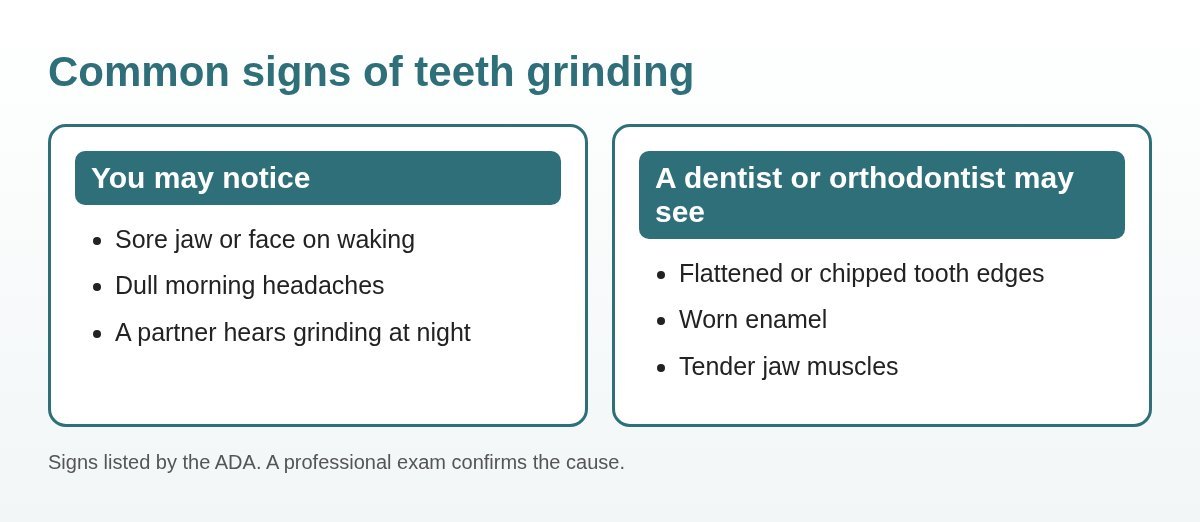
Most people who grind are not aware of it. According to the ADA’s guide to teeth grinding, dentists are often the first to notice, usually because of chipped or cracked teeth or worn spots along the edges. At home, you might notice:
- Pain or tenderness in the jaw, especially on waking
- Dull headaches
- Plugged, painful, or itchy ears
- Neck pain
Does a bad bite cause grinding?
Sometimes it plays a role, but it is rarely the whole story. The ADA lists stress, sleep disorders, teeth that don’t line up properly, and missing or crooked teeth as possible causes. It also notes that people who smoke or drink alcohol or coffee are about twice as likely to grind.
With that many possible contributors, straightening the teeth is not a guaranteed cure. What an orthodontist can do is check whether the way your teeth meet is adding strain, and whether correcting the bite is worth doing for its own reasons.
The relationship can also run the other way. The AAO’s deep bite explainer notes that regular clenching or grinding can intensify the wear a deep bite already causes on the front teeth. In that situation, fixing the bite helps protect teeth even if the habit itself continues. Our guide to deep bite treatment explains how orthodontists spot a deep bite and correct it.
Sleep grinding versus daytime clenching
The ADA notes that most people grind while they sleep, but many also clench or grind during the day, especially when they feel tense, worried, or pressured. The two habits show up differently, and it helps to know which one you are dealing with before talking to your orthodontist.
Sleep grinding is usually discovered secondhand. A partner or parent hears it, or a dentist spots flattened edges at a checkup. Morning jaw tiredness and headaches that fade as the day goes on are common clues. Daytime clenching is easier to catch yourself. Try a quick check a few times a day, such as at a red light or while studying: are your back teeth touching, and are your jaw muscles tight?
Awareness matters because daytime habits can be changed on purpose. The NIDCR recommends becoming aware of and reducing habits such as jaw clenching, gum chewing, and nail biting, and it describes biofeedback as one way some people learn to notice when they tighten their jaw muscles and relax them.
Practical steps that may ease grinding and jaw soreness
No single step stops grinding for everyone, because the causes differ from person to person. The measures below are low-risk and come from ADA and NIDCR guidance. Most can be started while you wait for an appointment.
- Work on stress. The ADA suggests asking your primary care physician about relaxation approaches, and lists meditation, counseling, exercise, massage, and deep breathing as effective options.
- Look at stimulants. Smoking, alcohol, and coffee are each linked with roughly double the odds of grinding, so cutting back is a reasonable experiment.
- Rest a sore jaw. For early jaw discomfort, the NIDCR lists soft foods, heat or cold paired with gentle stretching exercises, and over-the-counter pain relievers such as ibuprofen, taken as your doctor or dentist advises.
- Ask about sleep. If you are not getting enough rest at night, the ADA notes that a sleep study can show what is happening while you sleep.
Grinding during braces or aligner treatment
Moving teeth temporarily changes how they meet, and some researchers think that can trigger clenching. In one 2024 survey study of 80 patients at least six months into treatment, about 45% reported bruxism after starting. The most common complaints were jaw fatigue or soreness on waking, daytime clenching, and grinding. The authors found no link to facial type or type of bite. Keep the limits in mind: it was a small study based on self-reports, and other research cited in the same paper found no increase or even a decrease in grinding during treatment.
In practical terms, people who grind can usually still have orthodontic treatment, as long as the orthodontist knows about it. Heavy grinding can wear teeth and stress brackets, so an orthodontist will typically watch for loose brackets and unusual wear. With clear aligners, the trays cover the biting surfaces while they’re worn, and the AAO’s aligner basics call for at least 22 hours of wear a day. Ask whether clear aligners or braces make more sense if you grind heavily, and let the office know if a bracket breaks. Milnor’s orthodontic first aid page covers what to do in the meantime.
Night guards and orthodontic appliances
Dentists often recommend a night guard to protect teeth from grinding. The ADA says a custom guard made from a mold of your teeth gives the closest, most comfortable fit, while store-bought guards may not protect as well. Night guards are also different from sports guards, which the ADA’s mouthguard guidance describes as cushioned for impact.
During treatment, teeth are moving, so a guard made beforehand may stop fitting. Ask your orthodontist before wearing any guard with braces or aligners. Afterward, your orthodontist and dentist can coordinate retainers and a guard. Retainers matter here, because the AAO’s retainer guidance explains that teeth tend to drift back without them. The Milnor blog compares permanent and removable retainers if you are weighing options.
What the evidence says about guards and other treatments
A guard protects tooth surfaces, but it is not a proven cure for jaw pain. The NIDCR says these appliances, also called splints or occlusal splints, do not change the teeth or bite, and there is not a lot of evidence that they improve TMD pain. If one is suggested, make sure it is not designed to permanently change your bite, and stop wearing it and call your dentist if it causes pain.
Some people also ask about Botox. The NIDCR notes that botulinum toxin is not FDA-approved for TMDs and that study results have been mixed, so it is not a first-line answer for a sore jaw.
Grinding in children and teens
Parents often hear their kids grinding at night. The ADA says children grind often, but because their teeth and jaws grow so quickly, the habit doesn’t always cause serious damage, and many outgrow it by adolescence. In kids it usually isn’t stress. Possible causes include irritation in the mouth, allergies that make breathing harder, and teeth that don’t line up.
Some families also ask about ADHD. A 2026 systematic review found bruxism, nail biting, and poor oral hygiene were reported more often in people with ADHD, though study quality varied. Mention it if it applies, since it can shape how treatment is planned.
Grinding after braces come off
Finishing treatment does not end the grinding question. Retainers keep teeth in their new positions, and the AAO points out that teeth and bodies naturally change over time, which is why retainers are worn long term to minimize relapse. That is also the honest answer to a common search: teeth can move years after braces, especially when retainers are skipped.
For people who grind, a few practical points apply. A retainer that suddenly feels tight may mean teeth have shifted slightly, and the AAO advises calling your orthodontist if a retainer no longer fits as it did or causes pain. A worn, cracked, or loose-fitting retainer should be checked rather than forced in. Any night guard made before treatment was shaped around the old tooth positions, so it is unlikely to fit the finished smile. Ask your dentist and orthodontist together whether you need a separate guard, how it fits with your retainer schedule, and which one to wear on which nights.
Jaw pain is worth taking seriously
Not all jaw pain comes from grinding. The ADA lists sinus problems, infections, arthritis, injuries, gum disease, and jaw joint problems as other causes. Jaw joint and muscle disorders are grouped as TMD, and the National Institute of Dental and Craniofacial Research offers a useful TMD overview.
Two of its points surprise many people. First, research does not support the belief that a bad bite or braces cause TMD. Second, symptoms go away without treatment for many people, so experts recommend starting with conservative care and avoiding treatments that permanently change the teeth or bite. Simple habits help too, and the Milnor blog has tips on how to prevent jaw pain. If you have pain that doesn’t ease, clicking with pain, or trouble opening your mouth, see your dentist or orthodontist.
Getting help with grinding in Fort Collins
Grinding is common, and having it doesn’t mean you can’t straighten your teeth. It does mean your orthodontist should know about it from the start, along with any jaw pain or headaches you have noticed.
The evidence points in a few clear directions. Bruxism has several causes, including stress, sleep problems, and the bite itself, so braces are not a guaranteed fix. Some patients notice more clenching once teeth start moving, and that is worth reporting rather than ignoring. A custom night guard from your dentist protects teeth, but it has to fit your current teeth, so check before wearing one during treatment. And jaw pain has many possible sources, most of which respond to simple, conservative care.
If you are seeing flattened or chipped teeth, waking with a sore jaw, or wondering whether your bite is part of the problem, start with a conversation. An orthodontic exam at Milnor Orthodontics can look at how your teeth meet, how worn they are, and whether treatment makes sense now. Adults who have put off care for years can also read about adult orthodontics options before the visit. Bring notes on when your symptoms happen, morning or daytime, and any guard you already wear.
Frequently asked questions
Will braces stop me from grinding my teeth?
Not necessarily. Grinding has several possible causes, including stress and sleep problems, so straightening teeth is not a guaranteed fix. An orthodontist can tell you whether your bite is a factor.
Can I get braces or aligners if I grind my teeth?
Usually yes. Tell your orthodontist so they can plan around it and watch your teeth and appliances for wear during treatment.
What disqualifies you from getting braces?
There is no single rule. An orthodontist looks at your teeth, gums, and jaws before recommending treatment. Grinding on its own is something orthodontists plan around rather than a reason to say no.
Is teeth grinding an ADHD thing?
Not only. Grinding has many causes and is common in people without ADHD. A 2026 systematic review did find that bruxism and other oral habits were reported more often in people with ADHD.
Will teeth grinding ever go away?
Sometimes. The ADA notes many children outgrow it by adolescence. In adults, managing stress and other triggers may help, and a night guard protects teeth in the meantime.
Will teeth move 10 years after braces?
Teeth can shift at any age, which is why retainers matter. The AAO says wearing retainers as prescribed minimizes relapse.
Should I wear a night guard with braces?
Ask your orthodontist first. Because teeth move during treatment, any guard needs to fit your current teeth and not interfere with your plan.
At Milnor Orthodontics, our experts are here to help you achieve a priceless smile. Call our office at (970) 484-3214 or visit milnororthodontics.com to learn more. We're located at 1103 S. Shields St. in Fort Collins, Colorado.