When Does Your Child Need Braces? Age 7, 9–12 or 13–17? | Fort Collins Orthodontist
Reviewed by Dr. Laura D. Milnor, D.D.S., M.S. — orthodontist, Milnor Orthodontics, Fort Collins, CO. Dental degree and orthodontic residency, University of Iowa. Member, American Association of Orthodontists.
Most parents arrive at an orthodontist’s office with the same two questions, usually in the same order: does my child actually need braces, and when? The answers are less obvious than the marketing suggests, because “when” isn’t a single moment. It’s a sequence of decision points spread across roughly seven years of a child’s growth, and the right move at age seven is different from the right move at age twelve.
This guide walks through those decision points in order. What an orthodontist checks at each stage. Which problems benefit from early attention. And which ones are better left alone until more permanent teeth arrive. It also covers what treatment costs in Northern Colorado and how families typically pay for it, because that question deserves a straight answer rather than a form to fill out.
One thing worth stating up front: a large share of children evaluated early don’t need treatment yet. A good first visit often ends with a monitoring plan rather than a treatment plan. That’s a legitimate outcome, not a wasted appointment.
Why age 7 keeps coming up
The American Association of Orthodontists recommends every child have a first orthodontic check-up by age seven. The number sounds arbitrary until you look at what’s happening in a seven-year-old’s mouth.
By seven, most children have a mix of baby and permanent teeth. The first permanent molars have usually come in, which establishes the back-tooth bite relationship. The upper and lower incisors are erupting or already in place. That combination is enough to judge two things: how the jaws relate to each other, and how much room the remaining permanent teeth will have. And the bones are still growing, so they still respond.
It is a screening age, not a treatment age. The distinction matters. The visit exists so that a small number of problems get caught inside the window where growth can be guided, and so that everyone else gets told, accurately, to wait.
What an early evaluation is actually looking for
At a first exam, the specific things under assessment include:
- Crossbites, where upper teeth sit inside the lower teeth. A posterior crossbite can push the lower jaw off-centre as a child grows and bites around it.
- Severe crowding, where the arch clearly cannot accommodate the permanent teeth that are still queued up in the bone.
- Significant protrusion of the upper front teeth, which raises the risk of trauma to those teeth in falls and sports.
- Underbites, where the lower jaw sits ahead of the upper. This is one of the clearest cases for early intervention, since upper-jaw growth can be influenced in a way that becomes impossible later.
- Open bites and habits like prolonged thumb sucking or a tongue-thrust swallowing pattern.
- Missing, extra, or impacted teeth, often only visible on an X-ray.
- Early or delayed loss of baby teeth, which changes how the permanent teeth drift into place.
The AAO’s own position on early treatment is measured: it helps in specific situations, not universally. Published work on very early intervention reaches a similar conclusion — timing should follow the specific problem, not a general preference for starting sooner.
The age-by-age picture
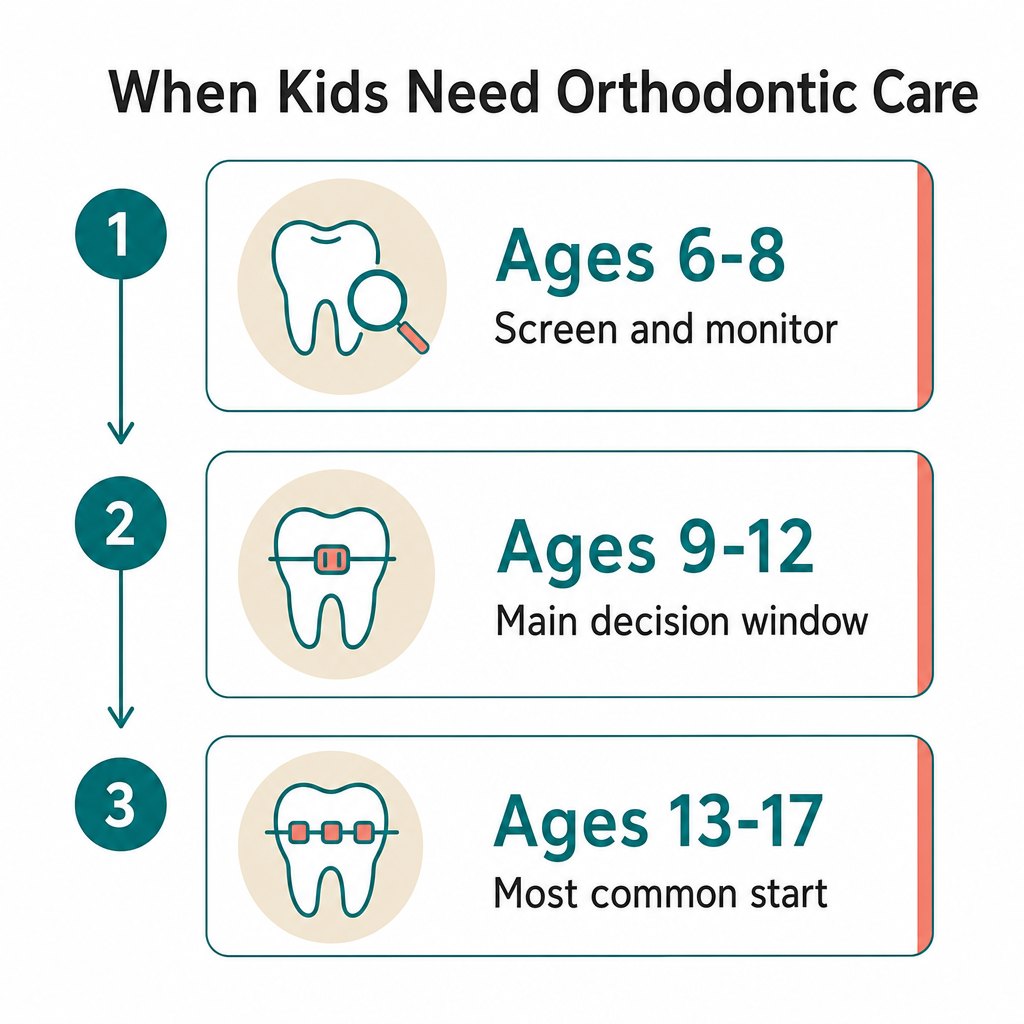
Ages 6–8: screening, and usually waiting
Most children in this range need nothing but a recall appointment. Growth records get started, the eruption sequence gets tracked, and the family goes home.
When early orthodontic treatment is recommended at this age, it’s usually one of a short list. Correcting a crossbite. Creating room with an expander. Addressing an underbite while the upper jaw can still be shaped. Holding space where a baby tooth was lost too soon. These are limited, targeted treatments rather than full braces, and they aren’t a substitute for the later phase.
Parents are sometimes told a Phase 1 treatment means their child will avoid braces entirely. That’s usually not true, and any practice promising it is overselling. What Phase 1 more often does is make the later phase shorter, simpler, or less likely to require extractions.
Ages 9–12: the main decision window
This is when most families make the real call. Permanent teeth are arriving in volume, crowding becomes obvious, and there’s still enough growth left to work with.
Treatment started here is typically comprehensive — full braces or aligners, correcting the whole bite. Options at this stage include traditional metal braces, which remain the most versatile appliance for complex movements, and Invisalign First, designed for the mixed-dentition stage where baby and permanent teeth coexist.
For children who are anxious about appearance — and plenty of ten-year-olds are — WildSmiles shaped brackets turn the appliance into something they choose rather than endure. It sounds cosmetic, and it is, but cooperation drives outcomes in this age group more than almost anything else.
Ages 13–17: the most common starting point
The majority of orthodontic patients begin here, with all or nearly all permanent teeth in place. Treatment planning is more predictable because there’s less growth left to estimate.
Teens choose between metal braces, ceramic braces that blend with tooth colour, and Invisalign for teens. The honest trade-off: aligners are removable and less visible, but they only work while they’re being worn. For a disorganised fourteen-year-old, fixed braces sometimes finish faster simply because compliance isn’t a variable.
Adolescent growth is also an asset. Some bite corrections need surgery in an adult. In a teenager, growth can do the same work. That’s a real argument against waiting until someone is “old enough to decide for themselves.”
What braces cost for a child in Fort Collins
There is no single price, and any article quoting one is guessing. Cost tracks case complexity, treatment length, and appliance type. A simple alignment case and a surgical-level bite correction are not the same product. Limited Phase 1 treatment costs considerably less than comprehensive treatment, because it’s doing considerably less.
What can be said precisely is how families pay for it.
What tends to matter more than the sticker figure:
- Insurance. Most dental plans treat orthodontics as a separate lifetime maximum, not part of the annual dental maximum. Coverage for dependent children often stops at a cut-off age. Milnor Orthodontics is in-network with Delta Dental, Aetna, Cigna PPO, and United Concordia, and files claims directly.
- Monthly payment plans. Through OrthoFi, treatment can start with a $250 down payment and monthly payments as low as $145, on a plan built around your budget. CareCredit offers interest-free financing over 6 to 24 months if paid in full within the term. Details on payment plans and financing.
- HSA and FSA funds. Orthodontic treatment is an eligible expense, which effectively discounts it by a household’s marginal tax rate.
- Multi-family discounts. If more than one child starts treatment at the same time, ask — most practices, including this one, discount it.
- The cost of Phase 1 if it prevents an extraction case. Harder to quantify, but a treatment that avoids removing permanent teeth changes the arithmetic.
A complimentary exam is worth using precisely because it produces a specific number for your child rather than a range from an article.
What treatment is like day to day
Braces are less disruptive than most parents expect and more of a hygiene project than they anticipate.
Discomfort is real for the first three to five days after placement and after each adjustment, and it responds to over-the-counter pain relief and soft food. It is soreness, not pain, and it does not recur at that intensity.
Hygiene becomes the parent’s job to supervise, for longer than feels reasonable. Brackets trap plaque. Plaque left sitting against enamel leaves permanent white marks, called decalcification. It’s the most common avoidable bad outcome in orthodontics. The CDC’s guidance for children’s oral health applies with more urgency during treatment, not less.
Diet changes. Hard, sticky, and chewy foods break brackets, and every broken bracket adds an unscheduled visit and time to the total. A list of foods to avoid is worth putting on the fridge for the first month.
Appointments are spaced several weeks apart through most of treatment, not weekly. Remote monitoring can cut the number further. The orthodontist reviews scans you take at home. For a family juggling school schedules across Fort Collins, Timnath, and Windsor, that’s a practical difference, not a technical one.
Retainers are not optional. Teeth move for life. The retention phase is the part of treatment that determines whether the result holds at twenty-five, and skipping it undoes work that took years. The ADA’s overview of orthodontics makes the same point.
When your child does not need braces yet
This section exists because almost nobody writes it.
Hold off if the only issue is crowding of baby teeth with permanent teeth still years away — spacing often resolves as the jaw grows and larger permanent teeth replace smaller primary ones. Hold off if a single tooth is rotated but the bite is sound and the remaining eruption is unfinished. Hold off if a child is in the middle of a growth stage where the picture will look materially different in twelve months.
Treating too early can mean a child wears appliances for years longer than needed. The fatigue that produces tends to arrive exactly when the important phase begins. Monitoring is a real clinical decision, and “come back in a year” is frequently the correct plan.
The reason to have the evaluation at seven is not to start treatment at seven. It’s to know which category your child is in.
Choosing an orthodontist in Fort Collins
A few things worth checking, none of which appear on a billboard:
Is the provider an orthodontic specialist? General dentists can legally provide orthodontic treatment. An orthodontist has completed two to three years of accredited residency after dental school, specifically in tooth movement and facial growth. For a straightforward case the distinction may not change the outcome. For a growing child with a developing bite, it frequently does. The AAO explains the scope of child orthodontics in more detail.
Do they present a monitoring option? A practice that recommends immediate treatment for every child evaluated at seven is not screening — it’s selling.
Will you see the same doctor? Continuity matters across a multi-year treatment, particularly one spanning two phases.
What’s included after the braces come off? Retainers, retention visits, and replacement policy should be explicit before you start, not discovered afterwards.
What technology are they actually using, and why? In-office technology is worth something when it shortens treatment, improves fit, or reduces appointments. A practice should be able to say which of those a given tool does.
Common questions
At what age should a child first see an orthodontist?
By age seven, per the American Association of Orthodontists. By then most children have their first permanent molars and front permanent teeth. That shows how the jaws relate, and whether there’s room for the teeth still to come. It’s a screening age, not a treatment age — most children evaluated at seven are simply monitored.
What age do most kids get braces?
Most start between nine and twelve, once permanent teeth arrive and crowding shows. Others start between thirteen and seventeen, once nearly all permanent teeth are in. Nine to twelve is the main decision window, because there’s still jaw growth to work with.
Does early treatment mean my child avoids braces later?
Usually not. Phase 1 addresses a specific problem — a crossbite, an underbite, severe crowding. It typically makes the later phase shorter or simpler rather than replacing it. A practice promising your child will avoid braces entirely is overstating what early treatment does.
How much do braces cost for a child in Fort Collins?
There’s no single price, because cost tracks case complexity, treatment length, and appliance type. Limited Phase 1 treatment costs considerably less than comprehensive treatment. Most dental plans carry a separate lifetime orthodontic maximum, and treatment is financed monthly — through OrthoFi, that can start at a $250 down payment with monthly payments as low as $145. HSA and FSA funds are eligible.
How often are appointments during treatment?
Several weeks apart through most of treatment, not weekly. Remote monitoring reduces in-office visits by letting the orthodontist review scans taken at home.
The short version
Get the evaluation at seven; expect to be told to wait. Make the real decision between nine and twelve for most children, or thirteen to seventeen for those whose bite develops without incident. Ask for the specific number and the specific plan rather than a range. Supervise brushing far longer than seems necessary, and treat the retainer as part of the treatment rather than an afterthought.
For families across Fort Collins, Loveland, Timnath, and Windsor, children’s and teen orthodontics at Milnor Orthodontics starts with an exam that ends in a straight answer — including, often, that nothing needs doing yet.
At Milnor Orthodontics, our experts are here to help you achieve a priceless smile. Call our office at (970) 230-3187 or visit milnororthodontics.com to learn more. We're located at 1103 S. Shields St. in Fort Collins, Colorado.