Custom Braces vs Regular Braces: What’s the Difference? | Fort Collins Orthodontist
Reviewed by Dr. Laura D. Milnor, D.D.S., M.S. — orthodontist, Milnor Orthodontics, Fort Collins, CO. Dental degree and orthodontic residency, University of Iowa. Member, American Association of Orthodontists.
Disclosure: Dr. Milnor serves on the scientific board for KLOwen Braces and is a key opinion leader for Dental Monitoring. Both are named in this article. That relationship is why she can explain how custom bracket systems are engineered — and it’s also why the limitations section below is included rather than omitted.
“Custom braces” sounds like a marketing upgrade — the orthodontic equivalent of leather seats. It isn’t, and the difference is more specific than most practices explain.
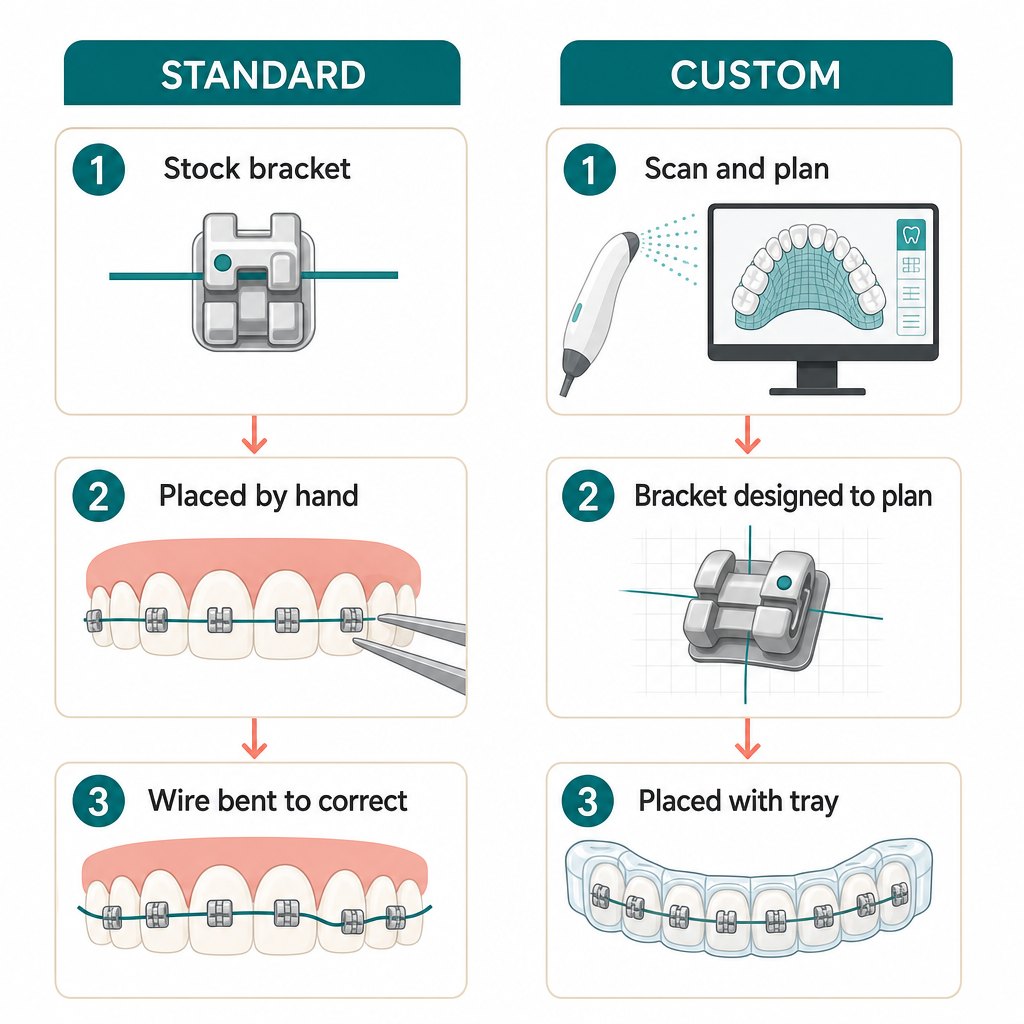
Standard braces use brackets manufactured in fixed sizes with a built-in prescription: a set of angles engineered into the bracket that tells each tooth where to go. Those angles are averages, derived from studies of typical tooth anatomy. They work, and they have worked for decades. The catch is that no individual patient is an average.
Custom braces reverse the order of operations. Standard braces fit the patient to a stock prescription, then make up the difference with wire bends along the way. Custom braces start from the patient’s own 3D scan. The prescription is calculated for their teeth and their target bite. This piece explains what that actually changes clinically, where it doesn’t matter, and how to tell whether the distinction is worth anything in your case.
How a standard bracket decides where your tooth goes
Every fixed bracket carries three engineered values:
- Torque — the facial-lingual inclination of the tooth root
- Angulation (tip) — the mesial-distal tilt of the crown
- In-out (thickness) — how far the bracket holds the tooth face relative to its neighbours
Together these form the prescription. When a straight finishing wire is fully engaged in a set of brackets, the teeth are pulled into the positions those three values dictate. That’s the entire concept behind straight-wire orthodontics: build the instructions into the hardware, then let a straight wire express them.
The system rests on two assumptions. First, that the built-in averages match your actual anatomy. Second, that each bracket is bonded in exactly the right spot. The prescription only comes out right if the bracket sits where the designer assumed it would.
Both assumptions leak. Real teeth vary in crown height, curvature, and thickness. And bonding a bracket by eye, onto a wet curved tooth, to within a fraction of a millimetre, is genuinely hard to do by hand.
Orthodontists have always compensated for the gap the same way: bending the archwire. Those finishing bends are skilled work, and they’re also the reason treatment stretches on. The ADA’s overview of orthodontics describes the general mechanism, though not this level of detail.
What changes with a custom system
A custom bracket system such as KLOwen starts from a digital scan of the patient’s teeth. The orthodontist plans the finished result first — where every tooth should end up — and the bracket prescription is then calculated backwards from that target, tooth by tooth.
Two things follow.
The prescription is patient-specific. Rather than a stock torque value chosen for an average upper canine, the value is derived from this canine, in this arch, moving to this planned position. Corrections that would have been dialled in later by hand are engineered in from the start.
Placement stops being freehand. Custom systems come with indirect bonding trays. The tray is a jig, built from the same scan, that seats every bracket in its planned position at once. The bracket goes where the plan says, not where it looked right through a mirror at a difficult angle.
That second point is easy to underrate. Because a bracket’s prescription is only expressed if the bracket is positioned correctly, placement accuracy and prescription accuracy are the same problem. A perfectly customised bracket bonded two millimetres off target is a customised error.
What it changes for the patient
Four practical differences, stated with the honesty this topic usually doesn’t get:
Fewer wire bends. When the correction is built into the brackets, less of it has to be added by hand at the chair. In practice that tends to mean fewer adjustment appointments, though how many depends entirely on the case.
More predictable finishing. The plan is defined digitally at the start rather than converged on iteratively, so the endpoint is less dependent on repeated adjustment.
Lower-profile hardware in some cases, because in-out thickness is set per tooth rather than compensating with bulk.
No difference in what it feels like. Custom brackets are not more comfortable in any meaningful sense. They are the same fixed appliance with the same soreness after adjustments and the same dietary restrictions. Anyone claiming custom braces hurt less is describing marketing, not mechanics.
Where custom braces don’t matter much
This is the section that establishes whether the rest of the article is trustworthy.
Mild cases. For minor crowding or a few rotations, a well-placed standard bracket with competent wire sequencing produces an excellent result. The customisation has less to express.
Aligner-appropriate cases. Many candidates for custom braces do just as well with clear aligners. Those are custom by definition, since every tray is made for the individual. If aesthetics matter more than mechanics, that comparison matters more than this one.
Cases where compliance is the real variable. No bracket design fixes missed appointments, broken brackets, or unworn elastics. Treatment length in those cases is driven by the patient, not the hardware.
Practices without the workflow. Custom systems need digital scanning, planning software, and indirect bonding as routine. A practice using the brackets without the workflow is buying the part and skipping the method.
Custom braces are a precision advantage in complex cases. In simple ones they are a reasonable choice that doesn’t change much. Anyone presenting them as universally superior is selling.
How they compare to the alternatives
| Standard braces | Custom braces | Clear aligners | |
|---|---|---|---|
| Prescription | Stock averages | Calculated per tooth | Per-patient by design |
| Placement | Freehand, direct | Indirect bonding tray | N/A |
| Complex bite work | Strong | Strong | Case-dependent |
| Visibility | Visible | Visible | Minimal |
| Depends on compliance | Low | Low | High |
| Wire adjustments | More | Fewer | None |
Metal braces remain the most mechanically capable appliance for difficult movements. Ceramic braces trade a small amount of that for appearance. Clear aligners remove the hardware question entirely but move the burden to wear time. A full comparison of the types of braces covers the rest.
For younger patients the choice is often driven by something else entirely — WildSmiles shaped brackets exist because a child who likes their braces wears their elastics.
Questions worth asking before you agree to any bracket system
- Why this system for my case specifically? A good answer references your bite, not the technology.
- Are you using indirect bonding? If the brackets are custom but placed freehand, most of the advantage is discarded.
- What’s the plan if a bracket comes off? Re-bonding a custom bracket accurately without the original tray requires a defined process.
- Does it cost more? Sometimes yes, sometimes not — but you should hear the actual number for your case alongside the payment plan options, not a range.
- What happens after? Retention determines whether any of this holds. Ask about retainers before treatment starts.
Common questions
What are custom braces?
Brackets designed from a 3D scan of your own teeth. The orthodontist plans the finished result first, and each bracket’s prescription — torque, angulation, thickness — is calculated backwards from that target. Standard brackets carry stock values derived from averages of typical anatomy.
Are custom braces better than regular braces?
For complex bites, yes — real gains in predictability and fewer wire adjustments. For mild crowding or simple rotations, a well-placed standard bracket produces an excellent result and the customisation has less to express. The diagnosis and treatment plan matter more than the bracket system in every case.
Do custom braces hurt less?
No. Same fixed appliance, same soreness after adjustments, same foods to avoid. Anyone claiming otherwise is describing marketing.
What is indirect bonding?
A tray built from your digital scan that seats every bracket in its planned position at once, instead of placing each one freehand. Because a bracket only delivers its prescription when positioned correctly, placement accuracy and prescription accuracy are the same problem.
The honest summary
Custom braces move one step of treatment out of the chair and into the planning stage. The fine correction gets calculated up front instead of estimated along the way. For complex bites, that’s a real advantage in predictability and appointment count. For simple cases, standard brackets in skilled hands do fine.
The variable that outweighs the bracket, in every case, is the diagnosis and plan behind it. A precisely manufactured appliance executing a mediocre treatment plan finishes a mediocre result very accurately.
At Milnor Orthodontics in Fort Collins, custom braces are one option among several. The complimentary exam is there to work out which one your case actually calls for — including when the answer is the standard one.
At Milnor Orthodontics, our experts are here to help you achieve a priceless smile. Call our office at (970) 230-3187 or visit milnororthodontics.com to learn more. We're located at 1103 S. Shields St. in Fort Collins, Colorado.